Thursday, August 16, 2012

We've relocated! 

Please visit Convene's current blog at pcmaconvene.com


Thursday, June 21, 2012

#TeachingTwitter


Aaron Hammer demystifies Twitter
In a recent column, we talked with industry experts about the fact that just because attendees aren’t using a conference hashtag or Twitter doesn’t mean they aren’t interested in social media. It could be that attendees just need a little hands-on help in using the tools.

Last week, at the 2012 Million Dollar Round Table (MDRT) Annual Meeting in Anaheim, Calif., MDRT not only set up a laptop-equipped "Tech Zone" as a learning lab on the exhibit floor, but Liana Blum, MDRT’s website coordinator, found the perfect tutors: other MDRT members.

Who better to tell others about the benefits of using Twitter at a meeting than someone already actively doing it? Blum recruited more than a dozen of the association’s most prolific Twitter users to volunteer for short blocks of time during several "Tweet Team" sessions throughout the four-day meeting.  And a big plasma screen showing a live Twitter stream featuring the conference hashtag provided instant gratification to the new Twitter users.
           
Aaron Lee Hammer, an MDRT attendee from St. Cloud, Minn., was both enthusiastic and patient as he guided first-time Twitter users through the process of choosing a handle, signing up on Twitter, and sending out a first-time tweet, using #MDRT2012. (“That’s you, my man,” Hammer told one Twitter newbie, pointing to the screen.)
           
Hammer likes to help others (volunteering is the “MDRT way,” Blum said), but he also has his own reasons to help others MDRT attendees learn how to converse via Twitter, he told me.  “The more people who use Twitter at the meeting, the more I know about what other members think are the best ideas."

Tuesday, June 12, 2012

My Alamo Moment

I'm here at the PCMA Education Conference in San Antonio. It's my first time in this great city, and I didn't want to leave here without making a trip to see the Alamo. Little did I realize that it is just a quick walk from our hotel, the Marriott San Antonio Rivercenter. Like many tourists who come upon the No.1–visited State Shrine in Texas for the first time, I was a little surprised by the site's scale. It looms so large in our American consciousness that the actual place — in the heart of a bustling downtown — seems much smaller than I imagined.

I thought about that when "Practical Futurist" Michael Rogers (see our interview with him in the May issue) spoke at this morning's general session. Staying on top of the latest technologies and figuring out how to implement them to benefit our industry seems overwhelming, given our growing day-to-day tasks. (As a former colleague used to say, "It's hard to build the house when you're washing the windows.") Rogers acknowledged that operational duties trump research and development — but R&D is critical to innovation. He recommended that you designate someone within your organization be removed (perhaps on a regular basis) from the operational side of things to talk to people and search the web — to do the actual work of seeking out and understanding new tools and technologies.

Designating someone to focus on that on a regular basis feels doable. And for me, something that I imagined to be such a huge thing seemed to shrink down to a manageable scale.

The Cure for Drowning


Steven Rosenbaum diagnosed the problem of digital overload at the 2012 DigitalNow conference, and offered a cure: associations. We are drowning in data, he said, and associations, with their deep knowledge of their organizations' interests and needs, are in a unique position to serve as filters and curators of information. "Content is no longer king," Rosenbaum said. "Curation is king."

The way forward is filled with challenges, but for those associations that get it, there are rewards, he wrote in The Huffington Post.
I think [associations have]  got the secret sauce to win big in the new world of Data Overload. Because publishers are fighting for fractionalized mindshare, while associations are poised to curate with authority. The challenge for them will be, can they build an internal information gathering, curating and distribution workflow that moves at the speed of the real time web?
For more from Rosenbaum, author of Curation Nation, see our story in the June issue of Convene.

Sunday, June 10, 2012

Convene On Site: Maui, Hawaii

Aloha! Now let's change the world.

For the past six days, I’ve been on a press trip in Maui, Hawaii, a place I’ve discovered to be one of the most economically and environmentally diverse places on the globe. Hawaii has always had a long-standing reputation as being one of the most beautiful places on earth, full of sun, sand, surf and some of the best people you could hope to meet. But, science? Not exactly what comes to mind when I picture this paradise. But after this press trip, it is. There are a plethora of organizations that groups can visit while at a conference in Maui, a potential meetings hotspot for the science and technology industry.

Here is a quick rundown of all the awesome organizations in Maui that are working to advance our scientific research, enhance our homeland security, and just generally make this world a better place:

1)

Pacific Biodiesel

How they're changing the world:

Owned and operated by husband and wife team Kelly and Bob King, Pacific Biodiesel, established in 1996, is the leader in biodiesel fuel production in Hawaii. They house the only 100% biodiesel-ran pump on the island. They collect used cooking oil from local restaurants and process it so that it can be used as fuel. Buses on Maui and Oahu, and the ferries to and from Pearl Harbor, are run on 20% biodiesel from their plant. It's a community-based project and all the fuel remains within the islands — exporting would cause pollution and waste energy. However, they help countries all over the world build and operate their own biodiesel plants — paying it forward in a big way.
Pacific Biodiesel plant in Maui. 

2)

Haleakalä Observatory

How they’re changing the world:

The Observatory, stationed at about 10,000 feet on Mt. Haleakala, houses one of the greatest technological wonders, the largest digital camera in the world. They have the ability to see and photograph further into space than almost anyone on the globe. They’ve spotted hundreds of undiscovered asteroids and deliberated how to change their path so as not to interfere with earth’s atmosphere or collide with the planet itself. (We were told the methods they use are vastly different from Bruce Willis in Armageddon). Ran by the University of Hawaii, the Observatory also provides great resources for students and amateur astronomers. 

Convene On Site: San Juan, Puerto Rico

I'm sitting on my balcony at the San Juan Marriott, winding down this press trip here in Puerto Rico.  I didn't know, having never visited Puerto Rico, that the unique aspects of this U.S. commonwealth would combine to create such an amazing experience, hospitality-wise. Puerto Rico is a mix of cultures, of course. Most everyone speaks both English and Spanish, and Latin and Spanish influences are everywhere. But it's also easy to get to, requiring no passport, and all conveniences are here--including the biggest Walgreens in the United States. The Condado area of San Juan is an interesting mix of urban nightlife, restaurants, residential homes, and several large, beachfront hotels like the San Juan Marriott & Stellaris Casino. This makes it a popular destination for tourists and other groups, but also for local residents. In fact, there were several proms and events going on at the hotel during our stay.
Ocean view from my room at the San Juan Marriott, Puerto Rico
This mix between resort-style amenities in an urban setting means that it's easy to reach some of the most popular attractions in the area like horseback/ATV tours, some of Puerto Rico's best restaurants, Old San Juan, and the Barcardi Distillery--all of which we visited during our time here. 
A street in Old San Juan, Puerto Rico, where you find a mix of Latin American, Spanish, and even Moorish-influenced architecture
Because this was my first press trip with Convene, I was interested to see what the other journalists I was traveling with would be curious about as we toured around San Juan. We were a group of writers covering business, group, and meeting travel and destinations, so most of our interests were focused there. But what's great is that the wonderful representatives of the Puerto Rico Convention Bureau did not forget that we're visitors to the island too, interested not only in the convention center and various sites (and we saw many great ones), but also in the people and attractions that make Puerto Rico a unique destination.

Tuesday, June 5, 2012

Un-Quiet Conversation


When I made plans to interview Susan Cain, author of Quiet: The Power of Introverts in a World That Can't Stop Talking, I suggested we meet in a coffee shop that, visually, exudes calm, the kind of place where patrons sip coffee at long wooden tables, surrounded by piles of crusty loaves of bread.

But, fresh from my reading of Cain's description of optimal environments for introverts — introverts have wide-open channels for stimulation — when I showed up to meet Cain, I became keenly aware of all the racket. Dishes clanked, conversations boomeranged off walls and ceilings, the piped-in classical music seemed intrusive. I could even feel the subway rattling underground.

Cain was extraordinarily gracious about the distractions and even allowed me to do a short video of her top takeaways for meeting planners about making meetings introvert-friendly.. And because it was really noisy, here's a transcript of what she said:
I think the most important thing for meeting planners to understand about introverts at a conference …  Well, there are really two things. One is that introverts really do need to recharge, and they are going to be at their best, at their most energetic, at their most socially open, if they get the time that they need to take breaks. And so it is not a good idea to encourage everybody to be going from morning until night. It is actually okay to be able to go back to your hotel room, or off by yourself to a café for an hour to take the break that you need. And so that is the first thing. 
And then the second one is that introverts are probably not that excited about breakout groups in the middle of the session and probably a lot of them feel like they are there to get information, and they actually want to hear the information from the speaker on the stage. And they might be less excited about doing a little breakout group where they chat with their colleague about what they just heard. There are exceptions to that.  It depends on the topic and the material. But in general, I would be careful about assuming that everybody enjoys breakout groups. They might act like they are enjoying them because they know that there is an expectation that they should, but the truth might be different from the face that they are showing.
You can read more from our conversation about introverts and meeting planning in the June issue of Convene.

Wednesday, May 30, 2012

Not-So-Great GoogaMooga: When Inaugural Events are Bashed on the Internet

The weather was ideal for the inaugural Great GoogaMooga, the first ever “foodie festival” in Brooklyn on May 19-20. But most attendees would say this was the only thing that was ideal. Glitches are to be expected with any inaugural event, however the not-so-great GoogaMooga — that seemed to be ruled by Murphy’s Law on Saturday when I attended — experienced heightened backlash from attendees via social media. The fact that the event started a half-hour late, the two-hour-long beverage lines, the mandatory (and confusing) drink tickets called “GoogaMoola,” the spotty cellphone reception, the high prices, the lack of shade, and that fact that some vendors ran out of food by 3 p.m. (even in the V.I.P. section), all combined to make that Saturday a less-than-perfect affair — and prompted a lot of attendees to take their frustration to the net. None of these mishaps would go unnoticed, or un-tweeted — with many references to The Hunger Games.

The crowds gather in front of the main stage at the Great GoogaMooga.
The event featured food from over 75 local restaurants, 20 musical performances, more than 35 winemakers, and 30 beer makers. It was called a “food amusement park,” meant to showcase the gourmet side of New York dining. The vendor booths, some curated by Anthony Bourdain, were arranged in a horseshoe surrounding a large stage where Hall & Oates and The Roots later played. Bourdain also spoke at the event (but only for those with a $250 V.I.P. ticket). 

Wednesday, May 23, 2012

On Site at CT2-MTL


© Barbara Haemmig de Preux

I'm here in beautiful Montreal, attending the first-ever C2-MTL Commerce + Creativity Conference. And this event just oozes creativity. It starts with the location — a former industrial corner of downtown called Griffintown, which is in the midst of revitalization. The conference is housed in a "village" of several distinct spaces. You enter through a large, sophisticated tent with piped-in fragrances and mood lighting, innovative lounges, cafeteria-style rooms, and an art installation of construction-cone walls (inside the center [peephole] of each cone is an image of innovative urban design). Once you exit the tent, you're in an urban outdoor space with a bar, music stage, and conversation pods with oversized Adirondack chairs.  The sessions themselves are held in the 1850s New City Gas building, a beautiful, stone building that was restored and outfitted specifically for the conference.

The conference's creative partner is Cirque du Soleil; content partners include Fast Company, IBM, and pwC, and its presenters include Laurentian Bank, Tourisme Montreal, and HSN. The line-up of speakers is equally impressive — especially considering that this is an inaugural event. Today, Arianna Huffington made use of her stage time to give us a sneak peek at her new "GPS for the Soul" app, and Ian Schrager gave us a glimpse into the creative genius behind each of his hotel designs. One nugget in particular settled in my brain: When asked how he plans the design for each of his hotels, Schrager said: "It's like a journey, not a plan."( I think I will use that line the next time someone asks me why we don't know what our cover story will be four months from now.)

If I put on my meeting-planner hat, I am sure I could find some flaws in this event's execution (the foie-gras-stuffed-flower appetizers yesterday evening, for one). But wow. There is so much to be mined from this event's format and environment — a creative act that reflects and supports the content.

Spicing Up the Trade-Show Floor

MyCEB's "Spice Market" at IMEX 2012
I'm currently at IMEX 2012 in Frankfurt, the annual powerhouse exhibition for incentive travel, meetings, and events. It's challenging for destinations to stand out in the exhibition hall, with exhibitors from more than 150 countries all trying to both get the attention of attendees, and to share the flavor and advantages of their destinations.

But the Malaysia Convention and Exhibition Bureau (MyCEB) booth was impossible to ignore Wednesday afternoon during its "Spice Market" cocktail reception, where they staged a modern version of the historical markets that thrived 600 years ago along the Silk Road. MyCEB distributed stacks of currency during the exhibition, and during the reception, attendees could buy colorful textiles, fans, and other items from "traders" who spread their wares out on cloths laid on the booth floor.

It was high-energy fun, and underscored the point that MyCEB makes about Malaysia as a meetings destination: the country sits at the crossroads of India and Asia, the fastest-growing economic area in the world, and offers meeting planners a multi-facted, multicultural environment.


Saturday, May 19, 2012

Power of People: Events After Controversy

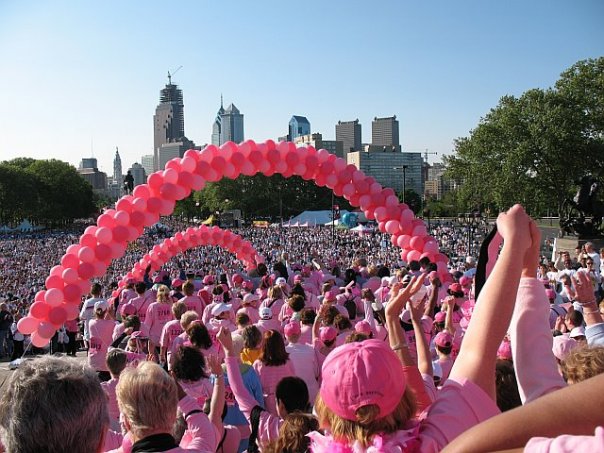
This Mother’s Day, as we do every year, my mother, sister and I participated in the Susan G. Komen Race for the Cure in Philadelphia. Just as I was impressed by the resilience of the breast cancer survivors competing (and kicking butt) in the race, I was also impressed by how, despite controversy faced this year, the Komen sponsored event was just as successful as in years past.

A sea of pink outside the Philadelphia Museum of Art
Photo courtesy of Susan G. Komen - Philadelphia
In the wake of a fierce media backlash after cutting funding for Planned Parenthood, and being accused of using their brand to promote unhealthy products, Susan G. Komen for the Cure has still managed to keep a majority of its supports, and not just corporate. At the 2012 Race for the Cure in Philadelphia — a 5k run culminating in a large celebration at the Philadelphia Museum of Art — there were more than 40,000 participants and 100,000 spectators, and the event raised over $900,000 dollars for breast cancer research and treatment.

It was reassuring to see that despite an organization’s trip-ups or difficult financial times, you can still count on the people to rally around a cause they’re passionate about. After my first month with Convene magazine, I’ve realized that that is the lifeline of the convention and meeting planning industry — the attendees who continue to show up, to join a group of like-minded people, to represent a subset of the community that they feel connected to, and to learn and grow as a result of these events.

Controversy or no controversy, my family and I, just like the other 140,000 people present that day, will continue to participate in the race, to support a worthy cause, to commemorate the women in our lives we’ve lost to breast cancer, support those that have survived, and fight for the future of women everywhere — proving that an organization is only as strong as its devoted members.

Photo courtesy of Susan G. Komen for the Cure - Philadelphia
Read Convene editor Barbara Palmer's interview with the founder of Susan G. Komen for the Cure, Nancy Brinker here:  http://www.pcma.org/Convene/Issue-Archives/December-2009/Leading-By-Example.htm.

Friday, May 18, 2012

What Price Knowledge?

I recently spoke with Michael Burke, a partner at Arnall Golden Gregory LLP, who chaired the American Bar Association's Section of International Law 2011 Fall Meeting in Dublin last fall. Something he said about the meeting — and the advantages Ireland provided as its host — reminded me of Convene Senior Editor Barbara Palmer's "What Price Knowledge?" sidebar in our May issue cover story.

Barbara talks about PAX East — which has agreed to hold its gaming conference at the Boston Convention & Exhibition Center for at least 11 more years — and its unique relationship with Boston's knowledge base, specifically the Massachusetts Digital Games Institute at Becker College.

Michael shared that one of the benefits of holding the fall meeting in Ireland was the ability to "leverage off of" The Irish Centre for Human Rights at the National University of Ireland, Galway — a renowned university-based institution for the study and promotion of humanitarian law. "The legal services industry in Ireland is as talented as you're going to get," Michael told me, but to to be able to have a speaker from that "human rights program, you know, it's a whole different perspective than we'd find elsewhere."

Checking In From Checkpoint Charlie

Near "Checkpoint Charlie" in Berlin
Convene is on the road again. I am on a pre-IMEX educational trip to Berlin, with planners from the U.S., Brazil, and China. Berlin is a beautiful city with a fascinating history, and is the fourth most-popular city globally for association meetings. I'll post pictures here, as well as on our newly activated PCMA Convene Facebook page.

My nearly first order of business in the city was to find a store where I could replace a computer cord I'd left behind. (It made me wonder if DMAI's Event Impact Calculator, which Corrie Dosh wrote about in our May cover story, calculates the purchases of all the things that meeting attendees forget and replace.)

But the store where I bought the cord was just a block or so away from "Checkpoint Charlie," the most famous former border crossing into East Berlin. There was a wonderful photographic timeline on the spot, telling the story of the Berlin Wall, which stood between East and West Germany from 1961 until 1989. Tourists waited nearby at a rebuilt guard station to get their photos taken with actors playing American guards.

I felt lucky that my errand gave me the opportunity to stand at that iconic spot — the likelihood of pleasure mixed with business is part of what makes for a great meeting destination.

Thursday, May 10, 2012

Convene On Site: Athens, Part 2

Following up on my post the other day, I need to reiterate the benefits of mixing media people and meeting professionals -- at least for we media people. During our many site visits over the last few days (including to the Westin Athens, where I'm sitting on my balcony writing this), it's been hugely instructive to hang back and watch my fellow participants -- an interesting and experience group that includes corporate and association planners, third parties, incentive professionals, and even an organizing committee member -- talk to our hosts and each other. They ask questions, clarify their needs, and offer solutions; you can see them sketching out an event in their heads, and trying to figure out if a specific venue will be an adequate canvas on which to paint it. For me, it's like auditing a master class.

PS The city is beautiful, the local meetings and hospitality community is warm, gracious, and expert, and the food is terrific. Wish you were here.

Tuesday, May 8, 2012

App-cidents Happen

The Old: 2010 DigitalNow app
Before I attended DigitalNow in late April, I went online to download the conference app, and mistakenly downloaded the app for the 2010 conference. The conference length, name, and the venue, Disney's Contemporary Resort, were the same both years, but it confused me for longer than I probably should admit.

Still, I'm glad I made the mistake, because it was eye-opening. (For starters, I saw the need to label conference apps with the year —lots of people, like me, operate at a gallop online, doing at least two other things while downloading your app.)

But the bigger, more important takeaway was the graphic example it provided of how quickly apps in particular, and tech in general, are evolving.

DigitalNow's bread and butter is technology, but their two-year-old app now seems pretty limited. It listed the agenda and speakers, along with sponsor logos and information about the resort, and offered embedded links to email and websites. But it functioned more like a digital version of a print conference schedule than a digital tool.
The New: 2012 DigitalNow


The 2012 app, by comparison, gave far more detailed and interactive information about sessions and speakers, offering attendees the opportunity to create their own personal agendas. Attendee bios and photographs were loaded into the app, attendees could link directly to the conference hashtag, sign up for text alerts (which were used judiciously), and physically find sessions and breakouts on a map of the convention center.

The app also connects directly to archived content; attendees can access videos of select sessions, including exhibitor presentations.

As good as it was, I wanted more. Specifically, I wanted to know which sessions were popular with attendees who were a lot like me. Social media platforms like Facebook, along with websites like Amazon, are training me to look for "recommendations" from people that I don't know well.

It is surprising to me that I expect so much, because not much more than a year ago,  I wrote a column about organizations that were developing their first conference apps. It was new ground to many of the people I spoke to, and unfamiliar territory for me as well. I didn't even know if I would like to use an app.

Today, I'm a big fan, and a recent Convene survey of meeting planners showed that more than 25 percent of respondents use them, a figure that almost certainly has grown since then.

What about you and your conferences? Are you using apps, and how are they changing?

Sunday, May 6, 2012

Convene On Site: Athens

Hello from Athens, where I'm participating in a fam trip sponsored by the Athens Convention Bureau. That beautifully hazy photo to the left is the view from my balcony at the Hilton Athens -- an accurate snapshot of this bright, hot, and heavy Sunday afternoon in the cradle of Western civilization, where it very appropriately happens to be election day.

We've only just hit the ground here, but already this trip has endeared itself to me for a very simple reason: We participants are a mix of media representatives and event planners, heavily weighted toward the latter. As an editor who covers the meetings industry -- reporting and writing on an area in which I have no formal training or education -- I'd much rather tour a destination with practitioners who can share their professional insights throughout our many site visits, meals, and other programs together. It helps me better understand how they approach the events they plan; and it also invariably suggests a lot of different ideas for Convene stories.

Something else that this trip is already doing right: doling out the downtime. Some of us arrived at the Hilton after traveling for more than 18 hours, and upon checking in our gracious hosts told us to relax and freshen up for a while; if we're interested, we can take a bus tour later this afternoon, followed by either an early dinner or simply cocktails and appetizers -- our choice. We're all excited to be here, but as you know it's not uncommon on a trip like this for the spirit to be willing and the flesh to be weak. It's nice to see that reality being taken into account.

If you're curious about what else makes for a good fam trip, check out this CMP Series article we published on the topic. And check back for another dispatch or two from Athens over the next few days.

Thursday, April 19, 2012

Live From TED2023


You decide if this is testament to the power of meetings in general or of the TED conference in particular: As part of their viral-marketing campaign for the upcoming summer blockbuster "Prometheus," filmmakers Ridley Scott and Damon Lindelof have released a TEDTalk from the year 2023 by one of the film's characters -- industrialist Peter Weyland, played by Guy Pearce. The three-minute video was created with the full cooperation of TED, and even has an official page on TED's blog, complete with "About This Talk" and "About the Speaker" tabs.

Why TED? "'Prometheus' takes place in the future, but it's a movie about ideas, and I just felt like it would be really cool to have one of the characters from the movie give a TEDTalk," Lindelof tells a TED interviewer. "Obviously, since the movie is set in the distant future, it would have to be a little more contemporary. But wouldn't it be cool if it was a TED talk from a decade in the future? And what is a TEDTalk going to look like in 10 years? And what would this guy have to say?"

Well, among other things, he might say that a conference is just the place to announce that you're going to change the world.

Friday, April 13, 2012

GSA: A Sort of Screed

Following up on Michelle's post about PCMA's recent webcast spinning off the GSA controversy -- I'm watching this case unspool from two different perspectives, each one maybe a little different from that of the general public: as someone who works in or for the meetings industry, and as someone who lives in the Washington, D.C., area. Thanks to the first perspective, I'm cautious about condemning the people who organized the GSA conference that's on its way to becoming the subject of congressional hearings, because at least some -- not all, but some -- of the things that are being most harshly criticized seem like the normal, necessary trappings of any meeting. The whole story is still shaking out, but I do wonder if some of what has people upset is based on a misunderstanding of how meetings are planned, and how much they cost. Shades of Muffingate, perhaps.

The second perspective is related to the first, but, of course, much more personal. Living in Arlington, Va., I have a number of friends and neighbors who work for the government -- indirectly, as contractors and consultants, and also directly, as federal employees. All of them are hard-working professionals who take their jobs seriously, and to see this controversy used as an occasion to mutter -- on talk radio and blogs and comments pages -- about lazy, overpaid government bureaucrats is upsetting. As if government employees shouldn't be meeting at all, anywhere, under any circumstances, because they serve at the pleasure of taxpayers.

Were elements of this meeting out of line? Yes, absolutely. Some of it was crazy tone-deaf; some of it was outlandish. But, as the Society of Government Meeting Professionals notes in its response:
[T]his apparent instance of excessive spending is newsworthy in part because it's unusual. ... The federal government maintains strict rules regarding spending and ethics when it comes to travel and, as in this case, when those rules are broken those responsible should be held accountable. The entire government meetings industry should not be judged on this one grossly "over the top" executed event. It clearly demonstrates the importance of agencies having a professional meeting planner versed in the proper processes of solicitation, contract awards and event execution, as required by government policy, the procurement process and ethical conduct standards.
Serious professionals need serious meetings, and serious meetings cost money -- more than most people realize, I think.

Thursday, April 12, 2012

Imagining Hawaii


At the Executive Experience fam trip to the Aulani, a Disney Resort & Spa, Joe Rohde, Disney's Chief Imagineer, described for participants what it was like to see his vision come to life. (You can read more about the fam trip in our April issue.)

Last June, Executive Editor Chris Durso talked to Rohde about the creative development process he led in creating the resort's design. You can read that interview here.

Ethics or Ignorance?

Last week's media storm over reports of the General Services Administration's (GSA) lavish Las Vegas conference for government employees served as the jumping-off point for a PCMA Webcast, Meeting Value & Strategic Measurement. It might have been the reason why the table was set for the discussion — between Webcast participants and PCMA President & CEO Deborah Sexton; Chairman of the PCMA Board of Directors Kent Allaway, CEM, CMP; and PCMA Senior Vice President of Education & Meetings Kelly Peacy, CMP, CAE — but it was not the meal that was served. Whether the GSA's overspending was the result of an ethical breach or ignorance, the focus of the Webcast was more on lessons learned and opportunities moving forward.

The media's portrayal of the GSA conference as an isolated instance of a government agency failing to follow federal travel regulations and making poor choices was encouraging, Deborah said at the beginning of the Webcast, because "this time, versus other sensationalized instances in the past, the public and Washington did not make sweeping judgments regarding the benefit equation of meeting face to face. Something is working." That "something" she attributed to the Economic Significance Study released last year, which was important in positioning the meetings industry as vital to the economy. But, she quickly added, "We're only halfway there. What we need to do is create a solid messaging campaign that talks about the benefits, other than economic, that face-to-face meetings create."

GSA serves as a glaring example of the need to continue to professionalize our industry. It's why, Deborah said, PCMA offers the education and tools that detail professional convention management standards on how to best define event objectives, clear measurements, and justification of spend, from RFPs, contracts, ethics, corporate social responsibility, third-party practices, and more.

"Professionals in our business understand the need for clearly defined goals and objectives that define not only what will take place at the meeting, but what will be accomplished at the end. This allows for budgetary recommendations and decisions to be made effectively at a person’s organization," Kent said. "Are we effectively evaluating the meetings we are holding? Are we attaching measurement to dollars that we are spending? Can you support that increased spending in one area resulted in increased attendance or education?"

Measurement is one thing; ethics is another. As Kent pointed out, there are a lot of opportunities in this industry "to make an incorrect choice." More training and mentoring is needed on ethical decision-making. Kelly noted that PCMA's membership application and renewal form includes the Principles of Professional and Ethical Conduct with 10 points "that serve to remind us" of appropriate behavior.

But ethical questions can be tricky. Plus, new ones evolve over time, Kelly noted. Kent said: "Transparency with your leadership will always pay dividends and result in a clear understanding, especially around expenses, trips, gifts, etc."

In addition to bringing ethical considerations to their attention, it's critical for planners to communicate consistently with their CEO on evaluation, strategic measurement, and spend justification, Kelly said, to be "proactive with reports" and make "spending vs. savings" a constant discussion.

Our biggest challenge, Deborah concluded, "is still in front of us: to create a global message on the value of individuals getting together face to face."

Here's the 30-minute Webinar in its entirety on PCMA365.