Tuesday, September 28, 2010

The Next Volcanic Eruption?

As we wrote in a story in the current issue of Convene, the airplane-grounding volcanic eruption in Iceland that seemed to come out of nowhere last spring wasn't a surprise to everyone: Kevin Mellott, president of Erase Enterprises, warned his clients that volcanic activity would probably interrupt air travel in Europe during the first six months of 2010. Forewarned, they sent clients home from Europe on prearranged alternate routes.

Now Mellott is recommending paying attention to a sister Icelandic volcano -- Katla -- which is even bigger than Eyjafjallajökull and potentially could blow in the next year. There's lots of talk about the Katla on survivalist blogs, but also at conferences like mid-September's "Atlantic Conference on Eyjafjallajökull and Aviation" in Keflavik. In a summary, the conference chairman wrote that it was generally accepted by volcanologists that the probability of another volcanic eruption in Iceland or elsewhere in the coming years is "high" -- with Katla as the primary suspect.

Some sources were downplaying the likely effect of the volcano, but not Mellott. He also wasn't optimistic that many planners were paying attention to the potential of another eruption. "The intelligence is out there," he said. "It's just a question of whether anyone is looking for it."

NASA image of Eyjafjallajökull

Monday, September 27, 2010

Convene On Site: The Peabody Orlando, Part 2

The press trip to The Peabody Orlando wrapped up in fine fashion on Saturday night, with a four-course, wine-paired, Northern California-themed dinner at the hotel's sharp new restaurant -- and it also represented something new for me. In my two-and-a-half years with Convene -- working in the meetings industry in my own way -- this is the first event to which my wife accompanied me, meaning that for the first time I didn't get to my hotel room and immediately call her to say, "Boy, I wish you were here." Instead, we were lucky enough to be able to share a very nice experience, from the site tour to that four-course dinner to the daily walking of the Peabody Ducks. In that way, the press trip did what the best meetings and conferences do -- created a sense of common history, something that a certain group of people experienced together and can look back on warmly. Especially those ducks.

Saturday, September 25, 2010

Convene On Site: The Peabody Orlando

On Thursday, The Peabody Orlando officially dedicated its $450-million expansion project, and this weekend the property is hosting a press trip to show off the results. And there's a lot of new stuff to show off -- such as 300,000 feet of beautifully designed meeting and convention space, a 31-story guest tower, a high-end spa and fitness center, and a swank cocktail lounge that wouldn't be out of of place on "Mad Men." That's on top of The Peabody Orlando's existing portfolio, which includes a prime location next to the Orange County Convention Center and, of course, the ever-lovable Peabody Ducks.

Thursday, September 23, 2010

A Bed Bug Battle Plan?

By now, you've surely heard about the first Annual North American Bed Bug Summit, held Tuesday and Wednesday at the Hyatt Rosemont in Chicago. The meeting brought together 14 of the world's leading entomologists to discuss the battle against bed bugs, which have come back with a vengeance in recent years, due most likely to the ban of pesticides like DDT.

Bed bugs are bad news for everyone -- they have closed down more than one store here in New York City, the bed-bug capital of the U.S. And, as a Wall Street Journal blog post points out, infestations inflict both physical and mental suffering. Although experts say that personal cleanliness is not a factor in infestation, there is considerable stigma attached to having bed bugs in your home or hotel.

Bed bugs are of particular relevance to the meetings industry because they can be spread, among other ways, through rented furniture, hotel mattresses, and luggage. So far, I haven't heard of any industry-wide campaign to address the bed bug surge, but it seems to me that a proactive, transparent, unified strategy would be a very good idea.

Wednesday, September 22, 2010

Welcome, Beck/Stewart/Colbert Nation!


I've written before about the pluses and minuses of living in a premier meeting destination like Washington, D.C., but I'm having problems figuring out whether the trio of "populist outrage" style events coming here over the course of two months is a plus or a minus. Glenn Beck kicked it off with his Restoring Honor rally, held at the Lincoln Memorial on Aug. 28, and Comedy Central's Jon Stewart and Stephen Colbert are following up with their own "dueling" events on Oct. 30 -- Stewart's Rally to Restore Sanity and Colbert's March to Keep Fear Alive.

Leaving politics completely out of the equation: It's pretty cool to live somewhere that's identified as a symbolically important place to convene, even if Stewart and Colbert are mostly riffing off Beck for as many laughs as they can get. The flip side is that, depending on who's holding a symbolically important rally here, there's a segment of the population elsewhere that equates D.C. with everything that's wrong with the country. You try not to take that personally, but sometimes it gets to you.

Tuesday, September 21, 2010

Context and Content

In her excellent post yesterday about a recent TEDTalk by TED founder Chris Anderson, Barbara Palmer wrote: "That serious magic, it seems to me, occurs between the speaker and his immediate audience. Would TEDTalks be as popular as they are without TED conferences?" It's a good question -- with implications for hybrid meetings (as Barbara pointed out), and also for the nature of conferences themselves, because it makes you -- okay, me -- think about whether they're defined more by their programming or by their format. In other words, content or context?

Extra, Extra!: Convene Newsstand


Welcome back to Extra, Extra!, Convene's weekly special supplement to our ThisWeek@PCMA newsletter. (Click here for the ThisWeek archive.) Let's see what's news:

The Wall Street Journal has a fun, splashy review of the decadent new 160-room Armani Hotel Dubai, the first such property by Giorgio Armani — where, because "Mr. Armani doesn't believe in waiting in lines," reception takes place in the guest's room. (Which begs the question: Would you want this amenity? We editors for Convene travel quite a bit for work, as you might imagine, and this writer, for one, isn't so keen on the growing encroachment by staff into guest space. No, I don't need a tour of the room, thanks; I can figure out how to operate the television all by myself.) At any rate, the Armani Hotel Dubai isn't alone: It will soon have fashion-world competition in the form of an 87-room Gucci property and a Palazzo Versace, both in Dubai.

Monday, September 20, 2010

When Is Video Face-to-Face?


Adrian Segar has written a very thoughtful post about the story about crowdsourcing I wrote for our September issue, and on a story on the same topic by Michelle Bruno.

Adrian’s post also tipped me off to a newly posted TEDTalk by TED founder Chris Anderson. In it, Anderson talks about the significance of the growth of online video and its revolutionary potential for "crowd accelerated innovation."

It's good stuff. Anderson includes some wonderful stories about how video is fueling innovation in fields as diverse as dance and community development.

But Anderson’s points about video also got me thinking about the definition of "face-to-face" communication. People watch TEDTalks as much for the non-verbal information they contain as for the ideas, Anderson said. Most of the speakers' ideas have already been expressed elsewhere, he said, but it is in the nonverbal portion of TEDTalks that there is “serious magic.” That magic occurs, it seems to me, between the speaker and his immediate audience. Would TEDTalks be as popular as they are without TED conferences?

Friday, September 17, 2010

In Defense of PowerPoint

We've gone on record as saying the Prezi presentation application is terrific, which, let's face it, carries with it an unspoken assumption that the dominant presentation application -- PowerPoint, of course -- is less than terrific. But Farhad Manjoo, writing in Slate, defends PowerPoint by identifying some of the common mistakes people make when using it and offering tips for avoiding those mistakes. He writes:
When people write annoying e-mails or make inscrutable spreadsheets, we don't blame Outlook and Excel; we blame the people. But for many of us, PowerPoint is synonymous with the terrible output it often generates. Because we've all been bombarded by so many awful PowerPoint-enabled talks, we've come to assume that slide software is a fundamentally bad idea -- that PowerPoint is a tool mainly for obfuscation and boredom, and that no good can come of it.
One of Manjoo's suggestions: "Skip the bullets." Yes. Any thought on how to diplomatically communicate that to your speakers?

Thursday, September 16, 2010

Where Would Robert Redford Meet?

If you were one of the world's best-known environmentalists, how would you go about building a conference center?

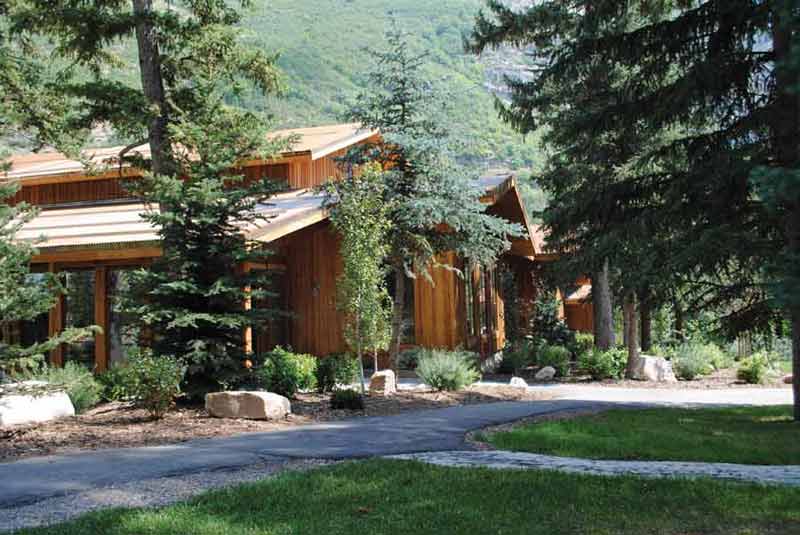
One answer can be found at the new Redford Conference Center, opening today at Redford's 5,000-acre Sundance Resort.

The resort already has in place an impressive set of green policies, which includes an on-site glass kiln (installed because of the difficulties of recycling in a remote mountain location) and car-pooling incentives, as well as a full-time naturalist and staff who carry out ongoing environmental restoration projects.

The new conference center is notable for its use of green building materials. The wood in the ballroom and pre-function areas is reclaimed barn materials, and staircase panels area from old Wyoming and Montana. A fireplace hearth was locally quarried, and 95 percent of the lights are LED or fluorescent.

It also uses geothermal heating and cooling, which pulls heat from the ground in the winter, and disperses heat into the ground in summer.

“This conference center will foster more people into collaborative ventures, more new ideas to flow, and more creativity to thrive on the mountain," said Redford, "all without overwhelming the natural space it inhabits."